
 2 Camden Pl, Patrick’s Bridge,
Home > Latest News & Guides > Signs of New Hair Growth After LLLT and What to Expect
Signs of New Hair Growth After LLLT and What to Expect
Contact us today
Date added: 31/05/26
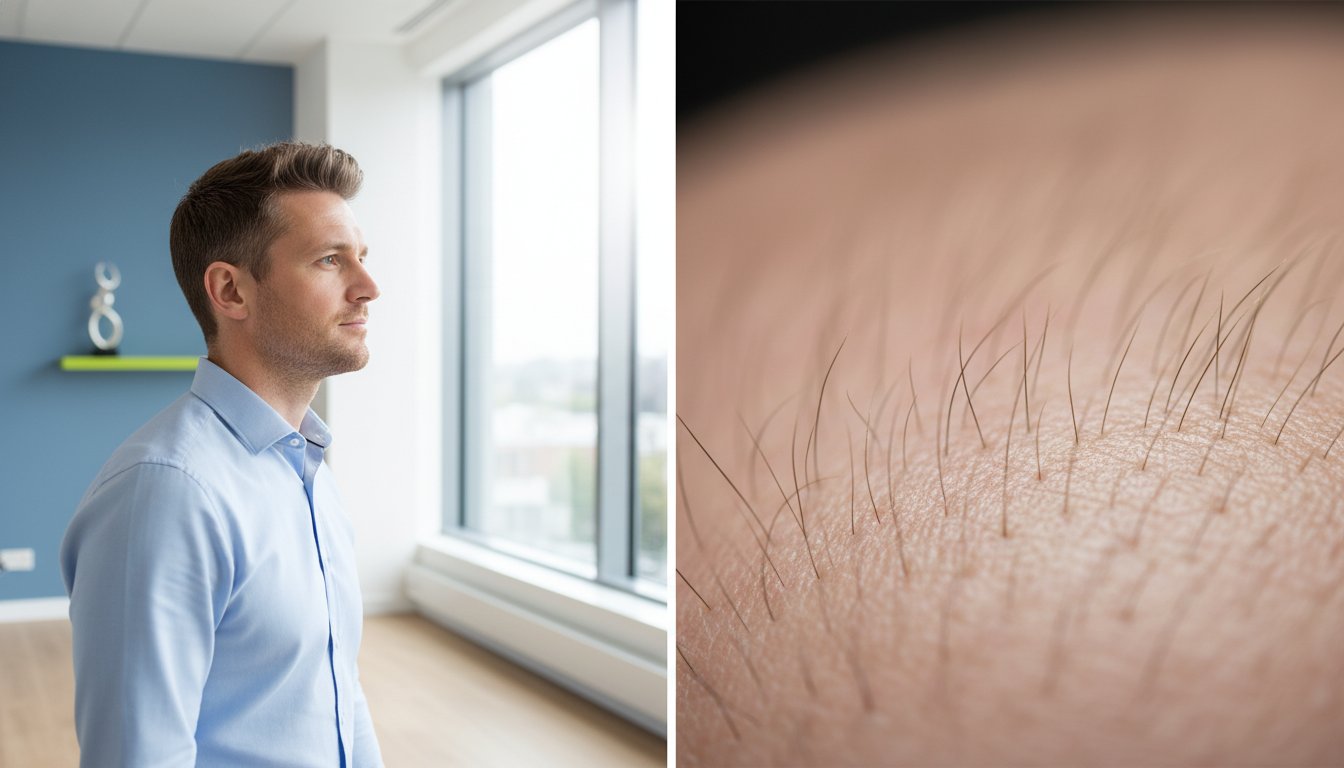
Seeing more hair in your brush after starting laser therapy is actually one of the most encouraging signs of success.
Whilst it feels counterintuitive, this initial shedding often signals that your follicles are transitioning into a more active phase.
Many people monitor their scalp daily for signs of new hair growth after LLLT, yet they feel deep anxiety when visible changes don't appear immediately. It's completely natural to worry about whether your investment is truly working or if you're simply waiting for a result that will never arrive.
We understand the emotional weight that comes with managing hair loss and the need for clinical certainty.
This guide will help you identify the subtle markers of progress, from the emergence of fine vellus hairs to the gradual increase in shaft diameter.
You'll discover a realistic timeline for visible density and learn why patience is your most valuable asset in this biological marathon.
By understanding these milestones, you can move forward with the quiet reassurance that your follicles are responding to the treatment and beginning to flourish.
Key Takeaways
- Understand why a temporary increase in shedding is a positive clinical indicator that your follicles are entering a more active growth cycle.
- Learn to identify subtle early markers of progress, such as improved scalp health and changes in the overall texture of your hair.
- Discover how to spot the first signs of new hair growth after LLLT by recognising fine, light-coloured vellus hairs in thinning areas.
- Gain clarity on the realistic biological timeline required to move from initial follicle stimulation to measurable density.
- Explore the advantages of clinical-grade laser hair therapy and the benefits of having your progress monitored by specialists in Ireland.
Table of Contents
If you are concerned about your current rate of shedding or want to discuss your progress with a specialist, you can reach out to our clinical team for a personalised assessment of your scalp health.
The Initial Biological Response and the Shedding Phase
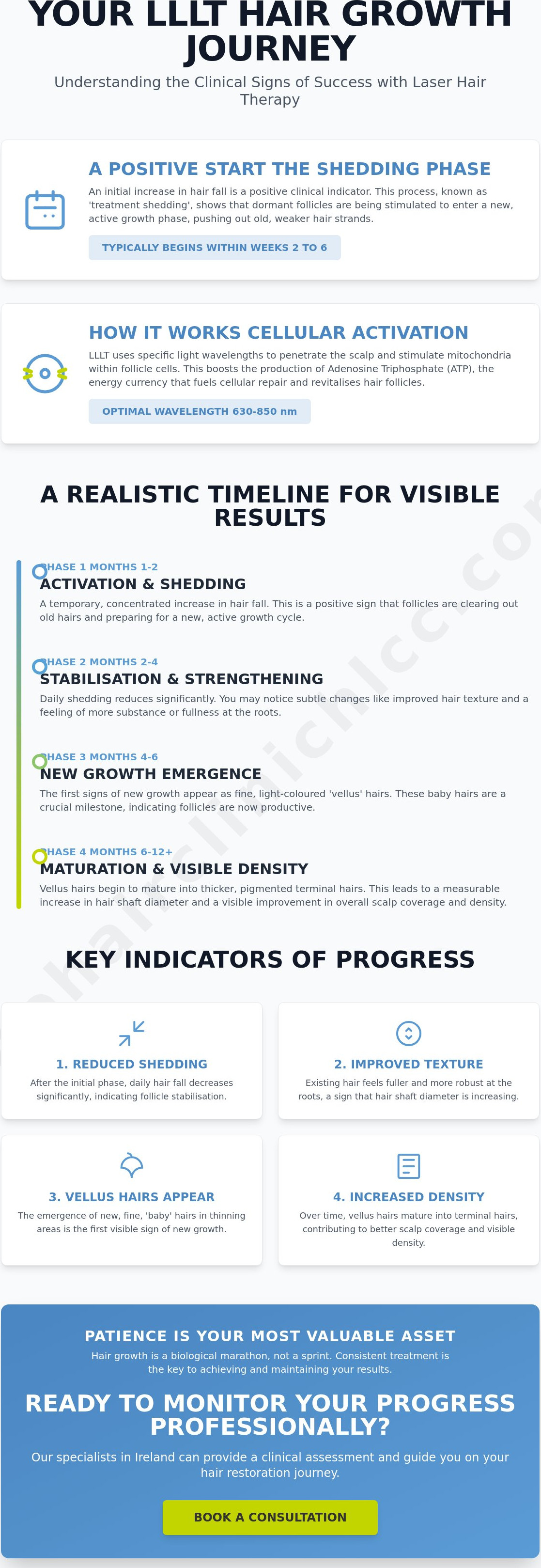
Starting a new treatment often brings a mix of hope and trepidation. When you begin using Low-level laser therapy (LLLT), the primary goal is to reawaken dormant follicles. However, the first visible change is often an increase in hair fall. This phenomenon is known as treatment shedding. It occurs because the laser energy encourages the follicle to prematurely exit the telogen resting phase and enter the anagen growth phase. For a new, stronger hair to grow, the old, weakened strand must be pushed out. Whilst it feels distressing to see more hair in the sink, this process is actually one of the most reliable signs of new hair growth after LLLT appearing in the near future. It is a biological reset that clears the path for healthier, more resilient hair follicles to emerge from the scalp.
Distinguishing between this clinical shedding and ongoing hair loss is a matter of timing and observation. Unlike the gradual thinning associated with androgenetic alopecia, treatment shedding is a concentrated, temporary event. It is a sign that the laser is successfully interacting with your biology. If you notice this shift, it means your follicles are responsive and the cellular machinery is beginning to function at a higher capacity. This phase is the necessary precursor to the visible density you are seeking. It is a biological restart.
Understanding the Cellular Energy Boost
The science behind this shift lies within the mitochondria. Laser light at specific wavelengths, typically between 630 and 850 nm, stimulates the production of Adenosine Triphosphate (ATP). This serves as the fundamental energy currency for cellular repair. This surge in energy is supported by improved local blood flow, which carries oxygen and vital nutrients directly to the root. These cellular changes are invisible initially, but they are essential for creating a healthier scalp environment. This proactive intervention is crucial because the biological window for preservation is limited.
Managing the Psychological Impact of Shedding
We recognise that increased shedding is emotionally taxing. It often triggers a fear that the treatment is failing. In reality, this is a sign of a high-functioning biological response. The follicles are clearing the deck to make room for robust terminal hairs. Treatment-induced shedding typically starts within the first two to six weeks and subsides shortly after. Staying consistent during this window is vital. By tracking these early signs of new hair growth after LLLT, you can maintain the confidence needed to persist. Trust the clinical process and focus on the restoration of your self-image.
If you would like to discuss your specific progress or seek a professional evaluation of your scalp condition, please get in touch with our specialists to arrange a consultation.
Subtle Early Signs of Progress Beyond Visible Length
Many patients expect to see new strands immediately. However, the first indicators are often tactile rather than visual. Once the initial shedding phase subsides, you may notice a significant change in how your hair behaves. This shift often manifests as a reduction in daily hair fall. A scientific review of LLLT studies confirms that laser therapy effectively stimulates the anagen phase, which helps stabilise the hair cycle. You might find that your hair feels more grounded and robust. This stability is one of the crucial signs of new hair growth after LLLT, as it proves the follicles are no longer in a state of distress.
It is common to feel a sense of fullness at the roots even before the length increases. This tactile density is a sign that the diameter of individual hairs is expanding. If you are unsure whether your current results are on track, you can book a progress review with our team. We can help you identify these subtle shifts and provide the reassurance that your treatment is working effectively. Patience is essential, but these early markers serve as the first milestones on your journey toward restoration.
Changes in Hair Texture and Strength
Existing hair often undergoes a transformation in quality before new growth breaks the surface. You might notice your hair feels thicker when you run your fingers through it or that it has regained a certain lustre. This happens because the laser energy improves the health of the hair cuticle. Stronger cuticles lead to less breakage and better light reflection, giving the hair a healthier appearance. Patients frequently report that their hair is easier to style and holds its shape better. These improvements indicate that the biological environment is becoming more supportive of healthy hair production.
Scalp Health as a Predictor of Growth
A healthy scalp is the foundation for successful hair restoration. LLLT helps regulate sebum production, which can reduce the oiliness or dryness that often accompanies hair loss. You may also notice a reduction in scalp inflammation or redness. These changes suggest that the laser is successfully increasing local circulation and calming the skin. For those looking to maximise these benefits, combining laser therapy with professional scalp hygiene treatments can further clear the way for new growth. A balanced scalp environment is a strong predictor that visible density is on the horizon.
If you are ready to track your progress with professional guidance and discover how laser therapy can restore your confidence, please book an appointment with our clinical team today.
Recognising Vellus Hair and Increased Density
After the initial cellular activation and texture improvements, the most exciting phase of your journey begins. This is when you can actually see the biological results of your consistency. The first visible signs of new hair growth after LLLT often appear as tiny, translucent sprouts. These are known as vellus hairs. Unlike the thick terminal hairs you are used to, vellus hairs are fine, short, and often lack pigment. They are frequently described as peach fuzz. This is a critical milestone because it confirms that follicles which were previously dormant or miniaturised are now functioning again. These fine hairs are the precursors to a fuller, more dense head of hair.
As treatment continues, these vellus hairs undergo a maturation process. Through the stimulation provided by laser hair therapy, the follicle gradually produces a thicker hair shaft with more pigment. This transition from vellus to terminal hair is what eventually creates visible density. Data from clinical trials on LLLT for hair growth show that this process is most effective when the treatment is maintained without interruption. You might first notice this new activity along your hairline or where you naturally part your hair, as these areas allow for easier observation of the scalp surface.
Spotting the First Fuzz of New Growth
Identifying these early sprouts requires careful observation. We recommend using a magnifying mirror and a bright, direct light source to inspect thinning areas. Look for very fine, light-coloured hairs that seem to have appeared recently. Whilst they may be difficult to see with the naked eye at first, they represent a significant victory in your restoration journey. As these hairs mature, they will begin to pick up more of your natural hair colour, making them far more noticeable against the scalp. This restoration of pigment is a clear indicator that the follicle's health is improving.
Density Changes and Filling the Gaps
Increased density is often felt before it is clearly seen in a mirror. You might notice a subtle resistance when you run your fingers through your hair near the scalp. This sensation occurs as the gaps between existing hairs begin to fill with new growth. To track this progress objectively, we suggest taking consistent photos of your parting every four weeks. Over time, you should see the scalp becoming less visible under bright bathroom lights. This gradual filling in of thinning patches is one of the most rewarding signs of new hair growth after LLLT. It provides the visual proof that your proactive approach to hair preservation is yielding results.
If you would like a professional estimate of your personal recovery timeline, please contact our clinic today to speak with a hair loss specialist who can help you set achievable goals.
Setting Realistic Timelines for Your Hair Growth Journey
Hair restoration is a biological marathon rather than a sprint. Whilst the cellular changes begin during your very first session, visible progress requires significant patience. Most users begin to see the first definitive signs of new hair growth after LLLT between three and six months of consistent use. This variation is usually due to individual factors like age, genetics, and the current stage of hair thinning. For instance, younger patients with early-stage thinning often respond more rapidly than those with advanced miniaturisation. Consistency is the most significant factor you can control. Skipping sessions disrupts the steady supply of energy to the follicles; this can reset the progress you have already worked hard to achieve.
To ensure you are moving in the right direction, it helps to understand that your hair grows in cycles. Each follicle operates on its own schedule, meaning that your entire scalp will not respond simultaneously. You might see improvements in the crown before the hairline, or vice versa. If you feel your progress has stalled, reach out to our team for a clinical review. We can help you adjust your routine and ensure you are maximising the potential of your laser hair therapy.
The Three Month Milestone
By the ninety-day mark, the initial treatment-induced shedding should have ceased completely. This is the period where vellus hairs typically emerge and the scalp environment begins to stabilise. It is vital to compare your current state to your baseline photos rather than relying on your daily reflection. Subtle changes are hard to spot in isolation, but they become clear when viewed over a three-month span. You can browse our patient testimonials to see how these timelines have unfolded for others in similar situations. Seeing these real-world results can provide the emotional boost needed to stay the course.
Long Term Maintenance for Lasting Results
Laser hair therapy is a powerful tool for preservation as much as it is for regrowth. Once you have achieved your desired density, you cannot simply stop the treatment. Hair loss is often a progressive condition; laser therapy works by actively counteracting that progression. We often advise a personalised maintenance programme to keep the follicles in the anagen growth phase. There is also a critical biological window of opportunity to consider. If a follicle has been dormant for too long and has completely closed, laser therapy cannot revive it. Proactive preservation is always more effective than attempting to regrow hair that has been lost for years.
To begin your journey with a professional scalp analysis and a clear understanding of your treatment options, please book your initial assessment at one of our local clinics.
Professional Laser Hair Therapy at Our Irish Clinics
Whilst at-home devices have made technology more accessible, clinical-grade Laser Hair Therapy remains the gold standard for those seeking maximum results. The primary advantage of professional treatment lies in the power and density of the laser diodes used within a clinical environment. These systems provide a more consistent and intense delivery of light energy to the scalp; this can significantly enhance the biological response of the hair follicles. Professional treatment also removes the guesswork. Our specialists use high-resolution scalp imaging to identify early signs of new hair growth after LLLT that might be invisible to the naked eye. This clinical oversight ensures that your protocol is working effectively and allows for adjustments based on your personal response.
Choosing a clinical setting also provides access to a supportive partnership. We understand that the journey toward hair restoration is as much about emotional wellbeing as it is about physical changes. By visiting our facilities, you receive the quiet reassurance of a team that has managed thousands of successful cases. We provide a grounded, medical perspective that helps you navigate the complexities of the growth cycle with confidence. This professional environment is designed to move you from a state of worry toward a proactive, solution-seeking mindset.
Specialised Care in Cork and Waterford
Our presence in Cork and Waterford allows us to provide world-class expertise within a local, accessible community context. We take pride in being a dedicated partner for our patients across the region. During your visits, we perform detailed professional scalp analyses to track follicular health and monitor the transition from vellus to terminal hair. We recognise that the needs of our patients vary significantly. We tailor our protocols specifically for men's hair loss and the unique challenges faced by women. This precision ensures that every session contributes to the restoration of your self-image.
A Holistic Approach to Restoration
We believe that the most successful outcomes often result from a multi-faceted strategy. Laser therapy is a powerful catalyst, but its effects can be amplified when used in synergy with medicated solutions such as DHT blockers or topical stimulants. This holistic approach addresses hair loss from multiple biological angles, ensuring that follicles are both protected from hormonal damage and energised for growth. Our specialists provide the professional guidance needed to organise these treatments into a cohesive plan. We invite you to take the first step by scheduling a complimentary initial assessment, where we can determine your candidacy and help you spot the first signs of new hair growth after LLLT on your own path to recovery.
If you are concerned about your progress or wish to begin your journey, book a complimentary consultation with our specialists today.
Restoring Your Confidence with Clinical Precision
Understanding the biological markers of success allows you to navigate the growth cycle with clarity and peace of mind. From the initial shedding phase to the emergence of fine vellus hairs, each stage is a vital component of your restoration journey. Recognising these early signs of new hair growth after LLLT is the first step in moving from a state of worry toward a sense of hope and proactive action. Our team provides clinical protocols based on global HLCC standards, drawing on over 20 years of experience in Irish hair restoration to guide your progress.
We create personalised treatment plans tailored to every stage of hair loss, ensuring your approach is as unique as your own biology. Consistency and professional monitoring are the foundational elements required to achieve lasting density and health. We are here to act as a dedicated partner, providing the expertise needed to support you at every milestone. Your path to a fuller head of hair starts with a commitment to your self-image and a proactive philosophy toward preservation. Trust the clinical process and look forward to the restoration of your confidence.
Frequently Asked Questions
Is it normal for hair to fall out when starting LLLT?
Yes, it is perfectly normal and often expected to experience temporary shedding when beginning your treatment. This shedding occurs because the laser energy stimulates follicles to transition from the telogen resting phase into the anagen growth phase. As the new hair begins its development, it pushes out the older, weaker strand. This biological reset is a clear clinical indicator that your scalp is responding to the therapy and preparing for healthier growth.
How long does it take to see the first signs of new hair growth after LLLT?
Most patients begin to observe the first visible signs of new hair growth after LLLT between three and six months of consistent application. Whilst cellular changes occur immediately, the physical manifestation of these changes follows the natural biological timeline of the hair cycle. You may notice improvements in hair texture or a reduction in hair fall sooner, but measurable changes in density typically require at least ninety days of regular sessions to become apparent.
What does new hair growth look like after laser treatment?
New growth typically appears as fine, translucent sprouts known as vellus hairs. These hairs are often much thinner and lighter in colour than your existing terminal hair, resembling a soft peach fuzz. Over time, with continued laser stimulation, these fine strands mature. They gradually become thicker, longer, and regain their natural pigment. This transition is a key marker of follicular recovery and a successful response to the laser energy.
Can LLLT regrow hair on a completely bald scalp?
Laser hair therapy cannot regrow hair on a scalp that is completely bald or where follicles have been dormant for many years. The treatment relies on the presence of viable, living hair follicles to be effective. It is designed to revitalise miniaturised follicles and extend the growth phase of existing hair. If the scalp has become smooth and the follicles have closed, the biological window for non-surgical intervention has likely passed.
How often should I use laser therapy to see results?
Consistency is vital, and you should follow the specific protocol recommended by your specialist or device manufacturer. In a clinical setting, sessions are organised to provide optimal stimulation without over-exposure. For at-home devices, this often involves sessions lasting between 10 and 30 minutes, performed several times per week. Missing sessions can significantly delay your progress, as the follicles require a steady supply of energy to maintain their active growth phase.
Will my new hair growth be the same colour as my original hair?
Your new hair will eventually match your original colour, though it often starts much lighter. When vellus hairs first emerge, they lack the full pigment found in mature terminal hairs. As the follicle continues to receive laser stimulation and blood flow improves, the hair shaft thickens and the production of melanin increases. This restoration of pigment is one of the most encouraging signs of new hair growth after LLLT during the maturation phase.
What happens if I stop using laser hair therapy?
If you stop using the therapy, your hair will eventually return to its previous state of thinning. Laser treatment is a preservation strategy that requires ongoing maintenance to keep the follicles in an active state. Without the regular surge of cellular energy provided by the lasers, the biological factors causing the hair to thin will likely take over again. We recommend a long-term plan to protect the density you have regained.
Can I use other hair loss treatments alongside LLLT?
You can certainly use other treatments alongside laser therapy to achieve enhanced results. In fact, many clinical protocols combine LLLT with medicated solutions like Minoxidil or DHT blockers for a synergistic effect. Whilst the laser provides a cellular energy boost and improves circulation, medicated treatments address the hormonal or nutritional aspects of hair loss. This multi-faceted approach often leads to faster and more significant improvements in hair density and scalp health.

Article by
Mark O'Sullivan
As Director of The Hair Clinic in Cork and Waterford, I am dedicated to helping our patients address their hair loss through expert trichological care. Our team provides professional laser hair treatments and personalised solutions to help clients restore their confidence.
Disclaimer
Please note that the information provided is for general guidance only and should not be taken as professional advice tailored to your specific circumstances.
Find out if Laser Hair Therapy is right for you
At The Hair Clinic, we make managing thinning hair simple and stress free. No more worrying about which products to trust, as we do all the hard work for you. Our Cork & Waterfood teams are here to help you find the perfect, clinically proven treatment plan to suit your goals.
Want to know how laser therapy can stimulate growth and what kind of results you could expect?
No problem. Get in touch with our friendly team today to book your free consultation, and we’ll be happy to help.
Related Hair Treatment News & Guides
If you liked this guide then you may also like the following:
Signs of New Hair Growth After LLLT and What to Expect
Seeing more hair in your brush after starting laser therapy is actually one of the most encouraging signs of success.Whilst it feels counterintuitive,...

Affordable Hair Loss Solutions in Waterford, LLLT Experts
Did you know that up to 85% of men and 50% of women will experience significant hair loss during their lifetime? It's a staggering figure that highlights...

Hair Loss Clinic Near Me in Cork and Waterford for Professional Restoration
Have you ever looked in the mirror and wondered if the person staring back is losing more than just their hair?For many people across Cork and Waterford...
Professional Laser Hair Treatment in Waterford
What if the reason your hair growth has stalled isn't just down to genetics, but a physical barrier resting directly on your skin?It's deeply frustrating...
DHT Blocker Scalp Treatment Ireland | Clinical Hair Restoration Guide
What if the most direct route to thicker hair didn't require the systemic risks of oral medication? For many people, the sight of thinning hair in the...
Laser Hair Therapy Cost in Ireland 2026 - Investment in Your Confidence
What if the most significant barrier to regaining your hair isn't the technology itself but the confusion about the required investment?For many people...